Semantic Concordance Methodology
Simple on the surface; rigorous underneath.
Non-negotiable safeguards
- Words do not equal concepts.
- A lemma does not equal all of its senses.
- Semantic relatedness does not equal theological equivalence.
- Discovery precedes exegesis but never governs it.
- Occurrence-level relevance requires study-specific contextual adjudication.
- AI candidates cannot become authority without independent review.
What Is a Semantic Domain?
A semantic domain is simply a group of words that belong to the same general area of meaning. Instead of studying a Greek or Hebrew word by itself, semantic-domain study asks, “What other words could the biblical writer have used to express a similar idea, and why did he choose this particular word?” For example, words such as love, compassion, mercy, kindness, and affection belong to overlapping semantic domains because they describe related ideas, even though they do not mean exactly the same thing.
This is important because words get their precise meaning from context, not merely from a dictionary definition. A Greek word may have several possible meanings, but the sentence, paragraph, book, historical setting, and comparison with related words help determine which meaning the author intended. Semantic domains therefore help us distinguish between possible meaning and actual contextual meaning. They also help prevent the common mistake of taking every possible dictionary meaning of a word and reading all of them into one verse.
In very simple terms, a semantic domain is like a “meaning neighborhood.” A word lives among other words that express related concepts. Bible study becomes more precise when we examine the whole neighborhood: which words are nearby in meaning, how they differ, where they overlap, and which particular sense best fits the biblical passage. This is especially valuable in Hebrew and Greek study because it moves us beyond “What does this word mean?” to the better question: “What does this word mean here, and why was it the appropriate word for what the author wanted to communicate?”
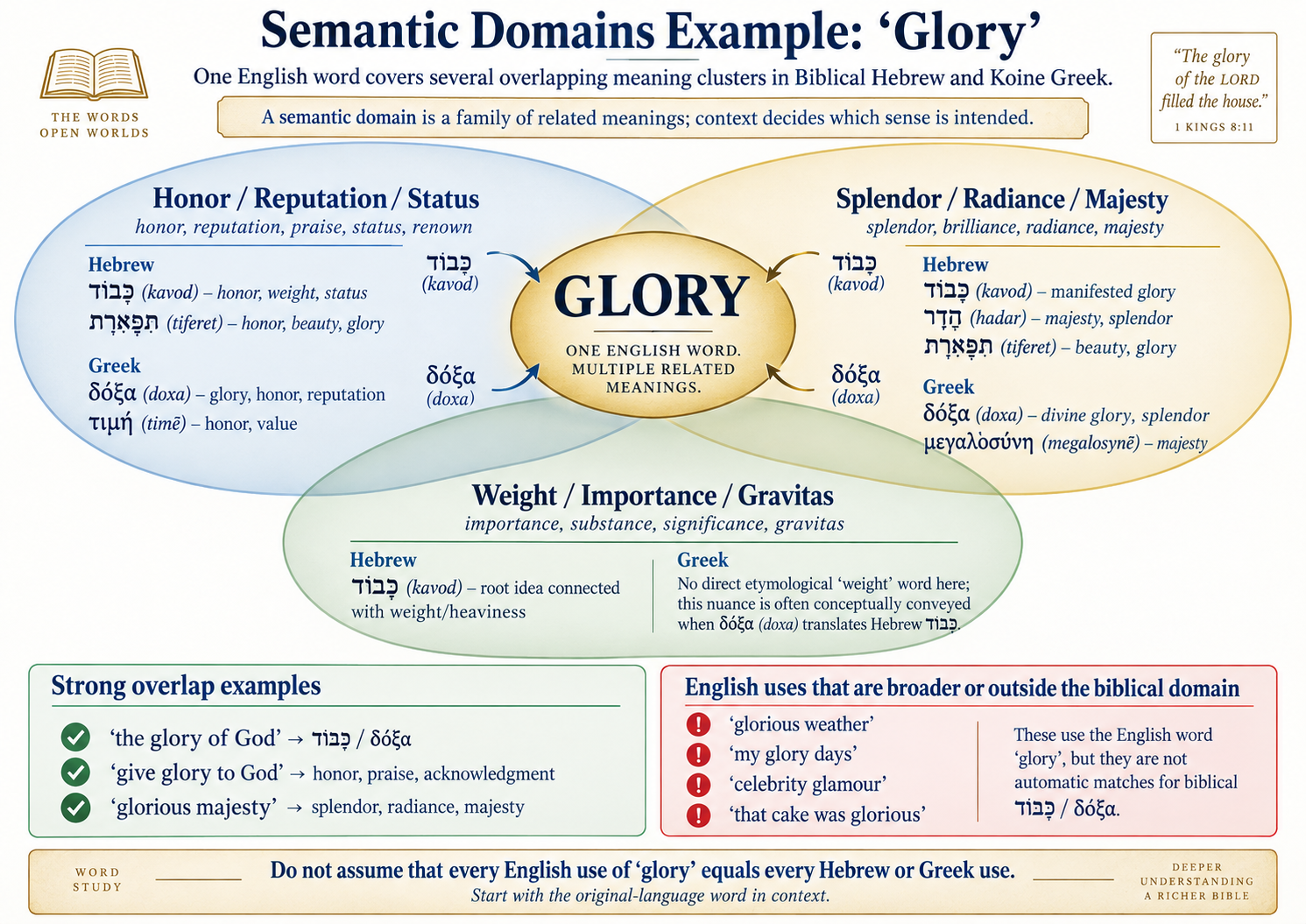
The basic principle is that semantic domains belong first to the original languages, not to English translations. The Old Testament was written mainly in Biblical Hebrew and the New Testament in Koine Greek. English is a later translation layer. So when studying a word in an English Bible, you first ask, “What Hebrew or Greek word stands behind this English word in this particular verse?” Then you study that Hebrew or Greek word within its own language: its possible meanings, the related words in its semantic “neighborhood,” and how the context determines the specific meaning here.
This matters because there is rarely a perfect one-to-one match between languages. One Hebrew word may require several different English words in different contexts, and one English word may translate several different Hebrew or Greek words. For example, the English word “love” can represent different Greek words with overlapping but distinct ranges of meaning. Likewise, a single Greek word may be translated as “love,” “affection,” or another expression depending on context. So the English word is useful, but it cannot by itself define the semantic domain. The domain must be reconstructed primarily from how the Hebrew word functions across Hebrew texts or how the Greek word functions across Greek texts. This fits the broader principle that contextual meaning is more important than simply collecting dictionary definitions.
The three-language process therefore works like this: English helps us locate the concept; Hebrew or Greek gives us the original lexical data; English then communicates the result back to the reader. We move from English → original Hebrew/Greek word → semantic domain in that original language → contextual meaning → careful English explanation. We should also avoid assuming that a Hebrew word and a Greek word belong to exactly the same semantic domain merely because English translates both with the same word. They may overlap greatly, partly, or only loosely. The safest question is always: “What does this Hebrew or Greek word mean in its own linguistic system and in this particular biblical context?”