
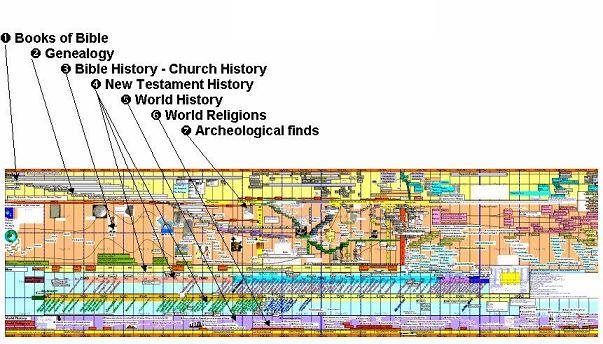
A Bible timeline chart provides a visual way to understand when the major people, events, kingdoms, prophets, empires, and periods of Scripture occurred in relation to one another. Instead of reading biblical history as a series of disconnected events, a chronological chart allows the whole biblical story to be viewed as an unfolding historical sequence—from creation and the patriarchs through Israel's history, the coming of Jesus Christ, the apostolic church, and the centuries of church history that followed.
This is especially valuable because the books of the Bible are not arranged entirely in chronological order. Prophets ministered during periods described in Kings and Chronicles. Psalms are connected with events in David's life. Ezra and Nehemiah belong to the Persian period. Paul's letters fit within different stages of the missionary history recorded in Acts. A Bible timeline chart helps bring these relationships together.
Use the Bible and church history timeline chart as a visual companion to your Bible study, allowing major biblical periods and later Christian history to be viewed within a single chronological framework.
What Is a Bible Timeline Chart?
A Bible timeline chart is a visual representation of biblical history arranged according to time. It normally places important events, people, kingdoms, empires, prophets, books, and historical periods along a chronological sequence so that their relationships can be seen at a glance.
A useful Bible chronology chart answers questions such as:
- When did Abraham live?
- Was Joseph before or after Moses?
- When did the exodus from Egypt occur?
- How long after Moses did David become king?
- Which prophets lived during the divided kingdom?
- Which prophets warned Israel before the Assyrian conquest?
- Which prophets ministered around the Babylonian exile?
- When did Ezra and Nehemiah live?
- What happened between the Old and New Testaments?
- Which empires ruled the Jewish people before Jesus was born?
- When did Jesus live in relation to the Roman emperors?
- When did Paul undertake his missionary journeys?
- Where do the New Testament letters fit into the book of Acts?
- What happened to Christianity after the apostolic period?
A chart makes these questions easier to investigate because events that occur in different biblical books can be placed side by side.
Why Use a Bible Timeline Chart?
The Bible contains historical material spanning many generations and many different political settings. Readers can easily remember individual stories while losing sight of how those stories relate chronologically.
A timeline corrects this problem by supplying a visual historical framework.
It Shows the Order of Biblical Events
A timeline makes the broad sequence immediately visible:
Creation → Patriarchs → Egypt → Exodus → Conquest → Judges → Kings → Divided Kingdom → Assyria → Babylon → Exile → Persia → Greek Period → Roman Period → Jesus Christ → Apostolic Church.
This sequence becomes the chronological skeleton upon which the details of biblical history can be placed.
It Connects People Who Lived at the Same Time
Many biblical figures who appear in separate books were contemporaries. Kings ruled while prophets preached. Foreign emperors rose to power while events recorded in Scripture were taking place.
A visual chart allows these people to be viewed together.
It Places the Prophets in Their Historical Context
The prophetic books can be especially difficult to place chronologically because the Old Testament does not arrange all the prophets by date.
Knowing that Isaiah ministered during the Assyrian period, Jeremiah during Judah's final decades before the Babylonian destruction, Ezekiel among the exiles, and Haggai and Zechariah after the return from Babylon fundamentally improves interpretation of their books.
It Connects the Bible With World History
Biblical history occurred within the wider ancient world. Egypt, Assyria, Babylon, Persia, Greece, and Rome were not merely background names. These powers profoundly affected Israel, Judah, Judea, and the early Christian church.
A Bible timeline chart can therefore show biblical events alongside the rise and fall of major historical empires.
The Bible Is Historical as Well as Theological
The Bible teaches theological truth through events that it presents as occurring in real history.
Abraham travelled from one region to another. Israel lived in Egypt. Moses confronted Pharaoh. Israel entered Canaan. David ruled from Jerusalem. Assyria conquered the northern kingdom. Babylon destroyed Jerusalem. Persia conquered Babylon. Jewish exiles returned. Jesus was born during the reign of Herod the Great. Pontius Pilate governed Judea when Jesus was crucified. Paul travelled through identifiable cities within the Roman Empire.
Biblical theology is therefore deeply connected with biblical history.
The Bible's central claims are not presented merely as abstract religious ideas. They involve God's acts within history, culminating in the incarnation, death, resurrection, and exaltation of Jesus Christ.
Bible Timeline Chart: Major Periods
The whole biblical storyline can be divided into major historical periods. These divisions provide a useful framework when reading Scripture chronologically.
- Creation and early human history
- Noah and the flood
- Babel and the dispersal of nations
- Abraham and the patriarchs
- Israel in Egypt
- Moses and the exodus
- Israel at Mount Sinai
- The wilderness generation
- Joshua and the conquest of Canaan
- The judges
- Samuel and the transition to monarchy
- Saul, David, and Solomon
- The divided kingdoms of Israel and Judah
- The Assyrian period
- The Babylonian period
- The exile
- The Persian period
- The return to Jerusalem
- The Greek and Hellenistic period
- The Maccabean and Hasmonean period
- Roman rule
- The birth and ministry of Jesus Christ
- The crucifixion and resurrection
- Pentecost
- The apostolic mission
- Paul's missionary journeys
- The later apostolic period
- The post-apostolic church
- Subsequent Christian history
Creation and the Beginning of the Bible Timeline
The biblical timeline begins with creation. Genesis presents God as the Creator of the heavens and the earth and humanity as uniquely created in the image of God.
The early chapters of Genesis establish the foundations for the rest of Scripture:
- God is Creator.
- Creation originally came from God's purposeful activity.
- Human beings bear God's image.
- Human sin entered the world through rebellion.
- Sin brought judgment and death.
- God continued to demonstrate mercy.
- Humanity spread throughout the earth.
Genesis 1–11 therefore provides much more than introductory history. It establishes the theological context within which the entire biblical storyline develops.
Adam, Noah, and Babel
After Adam and Eve, Genesis traces early generations of humanity and describes increasing human corruption. The flood in the days of Noah represents both divine judgment and preservation.
Following the flood, the descendants of Noah multiply. The events at Babel demonstrate another expression of human pride and rebellion, followed by the dispersal of peoples.
The biblical narrative then narrows dramatically. Instead of continuing to follow humanity generally, Genesis introduces a particular man through whom God promises blessing that ultimately reaches beyond one family and one nation.
That man is Abraham.
Abraham on the Bible Timeline
Abraham is one of the most important figures in biblical chronology because Genesis 12 marks a major transition in the biblical storyline.
God calls Abraham and gives promises concerning:
- descendants,
- a land,
- a great name,
- divine blessing, and
- blessing extending to the nations.
The remainder of the Old Testament repeatedly develops themes arising from these promises.
Abraham therefore stands chronologically and theologically between the primeval history of Genesis 1–11 and the later history of Israel.
The Patriarchal Timeline: Abraham, Isaac, Jacob, and Joseph
The patriarchal period follows several generations of the family chosen through Abraham.
The principal sequence is:
Abraham → Isaac → Jacob → the twelve sons of Jacob.
Jacob is also called Israel, and his sons become ancestors of the tribes of Israel.
Joseph's life then provides the historical explanation for how Jacob's family came to live in Egypt. What initially occurs as a means of preservation during famine eventually creates the setting for the opening chapters of Exodus.
By the time Moses appears, Abraham's descendants have become numerous but are living under Egyptian oppression.
Moses and the Exodus Timeline
The life of Moses represents one of the most significant periods in Old Testament history.
God calls Moses to confront Pharaoh and lead Israel out of slavery in Egypt. The sequence includes:
- Israel's oppression in Egypt
- The birth and preservation of Moses
- God's appearance to Moses at the burning bush
- The confrontation with Pharaoh
- The plagues upon Egypt
- The Passover
- The departure from Egypt
- The crossing of the sea
- The journey to Mount Sinai
- The giving of the covenant law
- The construction of the tabernacle
- Israel's wilderness rebellion
- Forty years in the wilderness
- Preparation for entry into Canaan
When Did the Exodus Take Place?
The date of the exodus remains one of the best-known chronological discussions in biblical studies.
An early-date view commonly places the exodus around 1446 BC. This approach gives significant weight to the chronological statement in 1 Kings 6:1, which relates Solomon's fourth regnal year to the departure of Israel from Egypt 480 years earlier.
A later-date reconstruction commonly places the exodus in the thirteenth century BC and attempts to correlate the biblical events with a different reconstruction of Egyptian and archaeological evidence.
The existence of different proposals illustrates an important principle when using a Bible timeline chart: not every biblical date has the same level of certainty.
Where Scripture and external historical evidence allow a firm chronological anchor, dates can be presented confidently. Where reconstruction is required, approximate or disputed dating should be acknowledged.
Mount Sinai and the Mosaic Covenant
After leaving Egypt, Israel arrives at Mount Sinai. This event is one of the defining moments of Old Testament history.
God enters into covenant relationship with Israel as a nation and gives His law through Moses.
The books of Exodus, Leviticus, Numbers, and Deuteronomy belong primarily within this broad Mosaic and wilderness period.
Understanding where these books belong chronologically prevents the law from being detached from its historical setting. The Mosaic law was given to a people whom God had already delivered from Egypt and constituted as His covenant nation.
Joshua and the Conquest of Canaan
Following Moses' death, Joshua leads Israel into the promised land.
The book of Joshua records:
- the crossing of the Jordan,
- the conquest of Jericho,
- major military campaigns,
- Israel's settlement within Canaan,
- the distribution of tribal territories, and
- renewal of covenant commitment.
The conquest represents an important stage in the fulfilment of God's promises to Abraham concerning the land.
The Judges Timeline
After Joshua, Israel enters the period recorded in the book of Judges.
This era is characterised by repeated spiritual and social deterioration. The book repeatedly presents a cycle:
Rebellion → Oppression → Cry for Deliverance → Judge Raised by God → Deliverance → Temporary Rest → Renewed Rebellion.
Important judges include:
- Othniel
- Ehud
- Deborah
- Gideon
- Jephthah
- Samson
The chronology of Judges can be difficult because some judges may have operated in different regions at overlapping times. Simply adding every chronological notice consecutively may therefore produce an artificially long period.
Ruth on the Bible Timeline
The book of Ruth explicitly places its story “in the days when the judges ruled.”
This small detail is chronologically important.
Ruth belongs historically to the judges period, even though the book appears later than Judges in the biblical arrangement.
The genealogy at the end of Ruth connects the story with David, showing that events occurring during the difficult days of the judges were part of the providential historical line leading to Israel's great king.
Samuel and the Beginning of the Monarchy
Samuel stands at the transition between the period of the judges and the establishment of Israel's monarchy.
Samuel functions as prophet, judge, and national leader. During his lifetime Israel demands a king like the surrounding nations.
Saul is anointed as Israel's first king.
The monarchy then proceeds through three major rulers during the united kingdom:
Saul → David → Solomon.
King Saul Timeline
Saul begins with significant advantages but ultimately demonstrates persistent disobedience.
His reign overlaps with the emergence of David, whose defeat of Goliath and later military successes bring him increasing prominence.
Much of 1 Samuel describes the difficult relationship between Saul and David, including David's years as a fugitive.
Viewing these events chronologically helps readers understand many Psalms associated with David's suffering, danger, trust in God, and eventual kingship.
King David Timeline
David is among the most important individuals on any Bible timeline chart.
His significance extends far beyond his political reign.
David:
- becomes king over Judah and later all Israel,
- establishes Jerusalem as his capital,
- brings the ark to Jerusalem,
- receives God's covenant promise concerning his royal house,
- becomes associated with much of the Psalter, and
- becomes a foundational figure in later messianic expectation.
The New Testament repeatedly identifies Jesus as the promised Son of David.
David therefore occupies a crucial chronological position connecting Israel's monarchy with the later biblical expectation of the Messiah.
King Solomon and the First Temple
Solomon succeeds David and rules during the final period of the united monarchy.
His reign is associated with:
- wisdom,
- international relations,
- economic prosperity,
- large building projects, and
- the construction of the temple in Jerusalem.
The construction of Solomon's temple is a major chronological and theological event.
Jerusalem becomes not merely the royal centre of David's dynasty but also the location of the central temple associated with Israel's covenant worship.
Solomon's later spiritual compromise, however, prepares the way for the division of the kingdom after his death.
The Divided Kingdom Timeline
Following Solomon's death, Israel divides into two kingdoms.
The northern kingdom retains the name Israel and consists primarily of tribes outside Judah's southern territory.
The southern kingdom is known as Judah and remains ruled by the Davidic dynasty.
Jeroboam I becomes the first king of the northern kingdom, while Rehoboam rules Judah.
From this point onward, Old Testament chronology becomes more complicated because the books of Kings frequently alternate between rulers of Israel and rulers of Judah.
A timeline chart is particularly helpful here because both monarchies can be displayed simultaneously.
Kings of Israel and Judah on a Timeline
The history of the divided monarchy involves numerous rulers whose reigns overlap.
The biblical writers regularly connect their dates by statements similar to:
“In the year of one king of Israel, another king began to reign in Judah.”
These chronological synchronisms are valuable for reconstructing the history of the two kingdoms.
A chart allows the reign of one king to be visually aligned with rulers of the other kingdom and with contemporary prophets.
This makes it easier to answer questions such as:
- Which king was ruling when Elijah ministered?
- Which kings lived during Isaiah's ministry?
- Which prophets spoke shortly before the fall of Samaria?
- Which rulers were involved in Judah's final years?
Elijah and Elisha on the Bible Timeline
Elijah and Elisha minister primarily within the northern kingdom during periods of severe covenant apostasy.
Elijah's confrontation with Ahab and Jezebel occurs within the history of the Omride dynasty.
Elisha continues prophetic ministry during subsequent political changes.
Placing these prophets on a chart makes clear that their miracles and prophetic confrontations took place during identifiable reigns rather than in an undefined legendary period.
The Writing Prophets on a Timeline
The prophetic books should be located within Israel's historical chronology whenever possible.
Broadly, they can be grouped according to several periods.
Prophets Before the Fall of the Northern Kingdom
These include prophets associated with the Assyrian era such as Amos, Hosea, Isaiah, Micah, and Jonah.
Prophets During Judah's Final Period
Jeremiah, Zephaniah, Habakkuk, and others minister against the background of Judah's declining years and the rise of Babylon.
Prophets During the Exile
Ezekiel and Daniel are especially associated with the Babylonian and exilic setting.
Prophets After the Exile
Haggai, Zechariah, and Malachi belong to the restored Jewish community of the Persian period.
A timeline makes these distinctions immediately visible.
Assyria on the Bible Timeline
The Assyrian Empire becomes one of the dominant forces affecting biblical history during the eighth century BC.
Assyria expanded westward and increasingly threatened both Israel and Judah.
The northern kingdom eventually fell when Samaria was captured in 722/721 BC.
This is one of the most important historical anchor points on an Old Testament timeline.
The northern monarchy ceased to exist as an independent kingdom.
Judah survived the Assyrian threat, most dramatically during the reign of Hezekiah when Jerusalem was threatened by the forces of Sennacherib.
Isaiah and the Assyrian Crisis
Isaiah's ministry overlaps with several kings of Judah and with the rise of Assyrian power.
Understanding this chronological setting is essential for interpreting many sections of Isaiah.
Political alliances, foreign threats, divine judgment, calls to trust God, and promises of future deliverance all occur against an identifiable historical background.
Without chronology, readers can easily treat these passages as disconnected predictions. With chronology, their immediate historical meaning becomes far clearer.
Babylon on the Bible Timeline
Assyria eventually declined, and Babylon became the dominant Near Eastern empire.
The rise of Babylon profoundly affected Judah.
Judah's final kings attempted various political strategies, but prophetic warnings emphasized that the fundamental problem was covenant rebellion rather than merely military weakness.
Babylon eventually invaded Judah repeatedly, deporting portions of the population and ultimately destroying Jerusalem.
The Destruction of Jerusalem in 586 BC
586 BC is one of the most important dates on the Old Testament timeline.
Babylonian forces destroyed Jerusalem and Solomon's temple.
The event marked:
- the collapse of the kingdom of Judah,
- the destruction of the First Temple,
- the end of Davidic rule from Jerusalem at that time,
- a major stage of the Babylonian exile, and
- the fulfilment of repeated prophetic warnings of judgment.
The destruction of Jerusalem provides important historical context for Jeremiah, Lamentations, Ezekiel, Daniel, Kings, and Chronicles.
The Babylonian Exile
The exile is a decisive period in biblical history.
Many Judeans were removed from their homeland and lived under foreign imperial authority.
Yet Scripture does not describe the exile as the end of God's purposes.
The prophets speak of judgment but also restoration, return, renewal, future covenant blessing, and messianic hope.
The biblical storyline therefore moves through judgment toward restoration.
Daniel on a Bible Timeline Chart
Daniel is particularly valuable for biblical chronology because his experiences connect several rulers and imperial periods.
His life begins within the Babylonian setting and continues into circumstances associated with subsequent imperial rule.
The book places God's sovereignty over earthly kingdoms at the centre of its historical and prophetic message.
On a Bible chart, Daniel serves as an important bridge between Judah's final monarchy, the Babylonian exile, and the transition toward Persian dominance.
Persia and Cyrus the Great
Babylon eventually fell to the Persian Empire.
Cyrus the Great permitted displaced populations to return to their homelands and restore religious institutions.
This change opened the way for Jewish exiles to return to Judah.
The Persian period therefore provides the historical setting for major restoration events recorded in Ezra and Nehemiah.
Ezra, Nehemiah, Haggai, and Zechariah
These books and figures belong within the broad post-exilic restoration period.
Major developments include:
- return from exile,
- rebuilding the temple,
- restoring worship,
- rebuilding Jerusalem's walls,
- renewing covenant obedience, and
- addressing continuing spiritual compromise.
The returned community lived again in the land but did so under Persian imperial rule rather than under a restored independent Davidic monarchy.
This unresolved situation contributes to the expectation that remains as Old Testament history approaches its close.
Where Does Esther Fit on the Bible Timeline?
The book of Esther belongs within the Persian period.
Its events occur among Jewish people who remained within the Persian Empire rather than returning permanently to Jerusalem.
This is an excellent example of why chronological charts are useful. Canonically, Esther is located among the historical books, but its setting is better understood when placed alongside the Persian Empire and the broader post-exilic period.
What Happened Between the Old and New Testaments?
A Bible timeline should not simply jump from Malachi directly to Matthew without acknowledging the significant historical developments that occurred between them.
During these centuries:
- Persian domination continued for a period.
- Alexander the Great conquered the Persian Empire.
- Greek culture and language spread widely.
- Alexander's empire was divided among successors.
- Judea came under competing Hellenistic powers.
- Antiochus IV Epiphanes attempted severe religious suppression.
- The Maccabean revolt occurred.
- The Hasmonean dynasty emerged.
- Rome became increasingly dominant.
- Judea eventually came under Roman authority.
These developments provide much of the political, cultural, and linguistic background of the New Testament.
Alexander the Great and Biblical History
Alexander the Great does not appear as a narrative character in the Protestant biblical canon, yet his conquests dramatically shaped the world into which Jesus was later born.
Greek language and culture spread throughout much of the eastern Mediterranean and Near East.
This process, known broadly as Hellenization, helps explain why Greek became an important international language in the New Testament world.
The New Testament itself was written in Koine Greek.
Thus, a broader Bible history timeline benefits from showing major world-historical developments that affected the setting of Scripture even when those events occurred between the canonical Testaments.
The Maccabees and the Hasmonean Period
The second century BC brought a major Jewish crisis under the Seleucid ruler Antiochus IV Epiphanes.
Religious suppression and desecration provoked resistance associated with the family of Mattathias and his sons, especially Judas Maccabeus.
The Maccabean revolt eventually contributed to a period of Jewish political independence under the Hasmonean dynasty.
These events shaped Jewish expectations, political tensions, and attitudes toward foreign rule before the Roman period.
Rome on the Bible Timeline
By the opening of the New Testament, Rome was the dominant Mediterranean power.
The Roman world forms the political framework of the Gospels and Acts.
Readers encounter:
- Roman emperors,
- Roman governors,
- Herodian rulers,
- Roman soldiers,
- Roman taxes,
- Roman citizenship,
- Roman courts, and
- Roman roads and cities.
The gospel of Jesus Christ therefore enters history within a specific political environment rather than an undefined religious setting.
Herod the Great and the Birth of Jesus
The Gospels locate the birth of Jesus Christ during the reign of Herod the Great.
This provides an important chronological anchor.
Because Herod died before the calendar system later called BC and AD was calculated, Jesus' birth is generally placed several years before AD 1.
This sometimes confuses readers who naturally assume that Jesus must have been born precisely in the year AD 1.
The discrepancy exists because the Christian calendar was calculated centuries after the events themselves.
The Life of Jesus Timeline
The four Gospels provide the principal sources for reconstructing the earthly life and ministry of Jesus.
A simplified sequence includes:
- The birth of Jesus
- His childhood
- The ministry of John the Baptist
- The baptism of Jesus
- The temptation
- The beginning of public ministry
- The calling of disciples
- Teaching and miracles
- Ministry throughout Galilee and other regions
- Journeys toward Jerusalem
- The final week
- The Last Supper
- The arrest of Jesus
- His trial
- The crucifixion
- His burial
- The resurrection
- Post-resurrection appearances
- The ascension
When Was Jesus Crucified?
Jesus was crucified while Pontius Pilate governed Judea.
Two dates commonly receive the greatest attention in detailed chronological reconstructions:
- AD 30
- AD 33
Calculations involve the chronology of Passover, Pilate's administration, Gospel details, and astronomical reconstruction.
While the exact year remains debated, the historical setting itself is well defined: Jesus' death occurred in first-century Roman Judea under Pontius Pilate.
The Resurrection on the Bible Timeline
The resurrection of Jesus stands at the centre of New Testament proclamation.
The apostles did not merely announce a system of moral teaching. They proclaimed that Jesus had died, was buried, had risen bodily from the dead, and had appeared to witnesses.
The chronology of the early church begins with this decisive event.
The resurrection is followed by post-resurrection appearances, the Great Commission, the ascension, and Pentecost.
Pentecost and the Beginning of the Apostolic Mission
Acts 2 records the outpouring of the Holy Spirit at Pentecost.
Peter publicly proclaims Jesus as the risen and exalted Messiah, and thousands respond.
The book of Acts then traces the widening movement of the gospel.
Its geographical progression broadly follows the pattern:
Jerusalem → Judea → Samaria → the Gentile world → Rome.
This makes Acts one of the most important books for constructing a New Testament timeline chart.
The Book of Acts Timeline
Major events in Acts include:
- Pentecost
- The growth of the Jerusalem church
- Persecution of the early believers
- The death of Stephen
- The spread of believers beyond Jerusalem
- Philip's ministry in Samaria
- The conversion of Saul
- Peter's encounter with Cornelius
- The development of the Antioch church
- Paul and Barnabas being sent on mission
- Paul's missionary journeys
- The Jerusalem Council
- Paul's arrest in Jerusalem
- Paul's imprisonment
- His appeal to Caesar
- His voyage to Rome
- His ministry while under Roman custody
Paul's Conversion Timeline
Saul initially appears as an opponent and persecutor of the Christian movement.
Acts records his dramatic encounter with the risen Christ on the road to Damascus.
His conversion transforms the direction of his life.
The persecutor becomes a preacher of the faith he once attempted to destroy.
Paul eventually becomes the most prominent missionary to the Gentiles described in Acts and the author of a substantial portion of the New Testament letters.
Paul's First Missionary Journey
Paul and Barnabas are sent from Antioch and travel through regions including Cyprus and Asia Minor.
The missionary pattern regularly involves:
- entering a city,
- proclaiming the gospel,
- speaking first within Jewish settings where possible,
- reaching Gentiles,
- facing opposition,
- forming communities of believers, and
- appointing leadership within developing churches.
A timeline allows Paul's travels to be placed in sequence and related to later correspondence with Christian congregations.
The Jerusalem Council
Acts 15 records the Jerusalem Council, an important event in the development of the early church.
The central controversy concerned Gentile believers and whether they were required to come under the Mosaic covenant in order to belong fully to God's people.
The council's decision confirms that Gentile salvation rests upon the grace of the Lord Jesus rather than upon becoming Jewish proselytes.
Chronologically, this event is important because it belongs within the expanding Gentile mission and helps explain the context of several later New Testament controversies.
Paul's Second Missionary Journey
During Paul's second missionary journey, the gospel advances into Macedonia and Achaia.
Major locations include:
- Philippi
- Thessalonica
- Berea
- Athens
- Corinth
Many of these cities later receive or relate directly to New Testament letters.
Placing these churches on a chronological chart therefore helps connect Acts with Paul's epistles.
Paul's Third Missionary Journey
Paul's later missionary activity includes an extended ministry in Ephesus and further interaction with previously established churches.
This period is especially important for reconstructing the circumstances surrounding several Pauline letters.
A Bible timeline chart can therefore integrate:
- Paul's movements,
- the churches he visited,
- letters he wrote,
- companions travelling with him, and
- events described in Acts.
Paul's Arrest and Journey to Rome
Paul's final major sequence in Acts begins with his return to Jerusalem.
He is arrested and becomes involved in a succession of legal hearings.
As a Roman citizen, Paul ultimately appeals to Caesar.
This results in his journey toward Rome, including the dramatic shipwreck described in Acts 27.
Acts concludes with Paul in Rome, proclaiming the kingdom of God and teaching concerning the Lord Jesus Christ.
Where Do Paul's Letters Fit on the Bible Timeline?
The letters of Paul are not arranged in chronological order within the New Testament.
They are traditionally grouped primarily according to recipient and length rather than by date of composition.
Consequently, a timeline chart can help readers connect letters with missionary activity.
For example:
- Thessalonian correspondence relates to Paul's relationship with the Thessalonian church.
- Corinthian correspondence belongs within Paul's extended interaction with Corinth.
- Philippians reflects Paul's continuing relationship with believers at Philippi.
- Romans is written to Christians in Rome before Paul's arrival there as recorded at the end of Acts.
Several exact dates remain debated, so good chronological study distinguishes strong historical conclusions from more tentative reconstructions.
Peter, John, James, and the Other Apostles
A New Testament timeline should not become exclusively a timeline of Paul.
Peter plays a central role in the opening chapters of Acts and in the expansion of the gospel beyond its earliest Jewish context.
James becomes an important leader within the Jerusalem church.
John continues as a major apostolic witness and is traditionally associated with later first-century Christian ministry.
The New Testament letters attributed to these figures help illuminate the wider apostolic church beyond the journeys of Paul.
The Destruction of Jerusalem in AD 70
AD 70 is one of the most important dates linking New Testament history with later Jewish and Christian history.
Following revolt against Rome, Jerusalem was besieged and the Second Temple was destroyed by Roman forces.
The destruction profoundly altered Jewish national and religious life.
It is also significant for understanding the historical transition from the first-century world of Jesus and the apostles into the later Roman period.
From the Apostles to Church History
A combined Bible and church history timeline should make an important distinction.
The biblical narrative possesses the authority of inspired Scripture.
After the apostolic age, continuous history must be reconstructed from other sources such as:
- early Christian writings,
- letters,
- Roman historians,
- inscriptions,
- archaeology,
- church records,
- council documents, and
- later historical testimony.
These sources are historically valuable but are not inspired Scripture.
Church history must therefore remain subordinate to the biblical text.
Early Christianity After the Apostles
After the first-century apostolic period, Christian communities continued spreading throughout the Roman world and beyond.
Early Christians faced major questions involving:
- faithfulness to apostolic teaching,
- persecution,
- false doctrine,
- church leadership,
- Christian conduct,
- the nature of Christ, and
- the relationship between Christianity and Roman society.
The history of this period demonstrates both continuity with apostolic Christianity and the gradual development of later institutions and traditions.
Christian Persecution in the Roman Empire
Christian persecution did not occur at exactly the same intensity throughout the entire Roman Empire or throughout every century.
There were periods of severe persecution as well as periods in which Christians lived with less systematic opposition.
Various Roman emperors and local authorities treated Christianity differently at different times.
Understanding this chronological variation prevents church history from being reduced to the simplistic idea that Christians experienced identical empire-wide persecution continuously for three centuries.
Constantine on the Church History Timeline
The reign of Constantine represents a significant turning point in the political history of Christianity.
Christianity moved from periods of imperial persecution toward legal recognition and eventually increasing imperial favour.
This did not mark the beginning of Christianity.
Christian churches had already existed for approximately three centuries.
Rather, Constantine marks a major change in the relationship between Christianity and Roman political power.
The Council of Nicaea
The Council of Nicaea in AD 325 is one of the best-known events in early church history.
It addressed serious controversy concerning the identity of the Son and His relationship to the Father.
Contrary to popular misconceptions, the council did not invent Jesus' deity. Christians had confessed Jesus as Lord and divine throughout the New Testament period and long before Nicaea.
The council represents a later historical attempt to formulate doctrinal language in response to controversy.
The Medieval Church Timeline
The medieval period covers many centuries and should not be treated as a single uniform era.
It includes developments involving:
- the decline of the western Roman Empire,
- missionary expansion throughout Europe,
- monastic movements,
- theological development,
- the growth of ecclesiastical institutions,
- political struggles between rulers and church authorities,
- the division between eastern and western Christianity,
- scholastic theology, and
- various reform movements.
A comprehensive church history chart allows these developments to be viewed in relation to one another rather than as isolated events.
The Protestant Reformation Timeline
The sixteenth-century Protestant Reformation becomes another major chronological landmark.
Numerous reform movements challenged doctrines, practices, and structures within medieval western Christianity.
Important figures include:
- Martin Luther
- Huldrych Zwingli
- William Tyndale
- John Calvin
- Thomas Cranmer
- Menno Simons
- and many others
From a conservative evangelical perspective, the Reformation's renewed emphasis upon the supreme authority of Scripture is particularly important.
Its effects also included widespread Bible translation, theological debate, confessional documents, educational reform, and the formation of multiple Protestant traditions.
The History of Bible Translation on a Timeline
The history of biblical translation can also be placed within the larger Bible and church history chronology.
Important milestones include:
- The Hebrew and Aramaic Old Testament writings
- The Greek Septuagint
- The composition of the Greek New Testament
- Early Syriac, Latin, Coptic, and other translations
- Jerome and the Latin Vulgate
- Medieval vernacular translation efforts
- Reformation-era Bible translations
- The printing revolution
- Missionary translation movements
- Modern Bible translation
Studying translation history helps explain how Scripture was copied, preserved, translated, distributed, and read across cultures and centuries.
Why Bible Timeline Dates Sometimes Disagree
Two Bible timeline charts may occasionally assign different dates to the same person or event.
This can occur for several reasons.
Ancient Regnal Systems
Ancient nations did not all calculate the beginning of a king's reign in the same way.
Some systems counted the partial year in which a ruler took the throne, while others began his first full regnal year with the next new year.
Co-Regencies
A father and son could sometimes exercise royal authority simultaneously.
If a chronology assumes every reign was completely consecutive, totals may become inaccurate.
Different Calendars
Ancient societies used calendars beginning at different points in the year.
These differences affect historical calculations.
Overlapping Events
Some periods may overlap geographically or politically rather than occurring consecutively.
Interpretation of Biblical Numbers
Scholars sometimes disagree about whether a number is intended as an exact chronological figure, a rounded number, or part of a particular literary structure.
External Historical Reconstruction
Ancient Near Eastern chronology itself depends upon interpreting inscriptions, king lists, astronomical records, archaeology, and other evidence.
Responsible charts should therefore distinguish between firm dates, approximate dates, and disputed dates.
How Are Bible Timeline Dates Calculated?
Biblical chronologists draw upon several types of evidence.
Biblical Chronological Statements
The Bible contains ages, years, reign lengths, genealogies, travel periods, and chronological intervals.
Synchronisms Between Kings
Kings of Israel and Judah are often dated relative to one another.
Foreign Rulers
Biblical rulers sometimes interact with kings known from Assyrian, Babylonian, Persian, Greek, or Roman sources.
Ancient Inscriptions
Inscriptions may record military campaigns, tribute, kings, cities, nations, or significant events.
Astronomical Data
Some ancient records contain astronomical information capable of providing chronological anchor points.
Archaeology
Archaeology can help establish historical settings, destruction layers, settlement changes, and material culture.
The most reliable chronology usually emerges where multiple independent forms of evidence converge.
Bible Timeline Chart and Archaeology
Archaeology can greatly illuminate biblical history, but it must be used carefully.
Archaeological evidence can reveal:
- ancient cities,
- fortifications,
- destruction layers,
- inscriptions,
- pottery,
- burial practices,
- economic activity,
- settlement patterns,
- trade, and
- political conditions.
It cannot ordinarily prove every personal event described in Scripture, since most human activities leave no identifiable archaeological trace.
Archaeology is therefore most useful when it illuminates the historical world of Scripture rather than being asked to function as a substitute for the biblical text.
Bible Genealogies and Chronology
Genealogies are frequently used when constructing biblical timelines.
However, biblical genealogies serve several purposes besides chronological calculation.
They may establish:
- family descent,
- tribal affiliation,
- legal inheritance,
- royal legitimacy,
- priestly qualification,
- historical continuity, and
- theological relationships.
Matthew's genealogy of Jesus, for example, intentionally highlights His relationship to Abraham and David.
Luke's genealogy extends the line back to Adam.
Both are historically meaningful while also serving theological purposes.
BC and AD on a Bible Timeline Chart
Most traditional Christian timelines use BC and AD.
BC means “Before Christ.”
AD comes from the Latin Anno Domini, meaning “in the year of the Lord.”
Some academic works instead use BCE and CE, meaning “Before Common Era” and “Common Era.”
The numerical dating is normally identical.
Thus:
- 586 BC = 586 BCE
- AD 70 = 70 CE
Another important point is that the conventional historical system contains no year zero. The sequence moves directly from 1 BC to AD 1.
Old Testament Bible Timeline Chart at a Glance
| Period | Major People or Events |
|---|---|
| Primeval History | Creation, Adam and Eve, Noah, Flood, Babel |
| Patriarchal Period | Abraham, Isaac, Jacob, Joseph |
| Egypt and Exodus | Moses, Pharaoh, Passover, Exodus |
| Wilderness | Sinai, Mosaic Covenant, forty years |
| Conquest | Joshua, entry into Canaan |
| Judges | Deborah, Gideon, Samson and other judges |
| United Monarchy | Saul, David, Solomon |
| Divided Kingdom | Israel and Judah, kings and prophets |
| Assyrian Period | Fall of Samaria, Assyrian threat to Judah |
| Babylonian Period | Fall of Jerusalem, exile |
| Persian Period | Cyrus, return, Ezra, Nehemiah |
| Post-Exilic Period | Haggai, Zechariah, Malachi |
New Testament Bible Timeline Chart at a Glance
| Period | Major People or Events |
|---|---|
| Birth and Childhood of Jesus | Herod the Great, Bethlehem, Nazareth |
| Beginning of Jesus' Ministry | John the Baptist, baptism, calling disciples |
| Public Ministry | Teaching, miracles, kingdom proclamation |
| Final Week | Jerusalem, Last Supper, arrest and trial |
| Crucifixion and Resurrection | Death, burial, resurrection appearances |
| Early Church | Ascension, Pentecost, Jerusalem church |
| Expansion | Judea, Samaria, Gentile mission |
| Pauline Mission | Conversion and missionary journeys |
| Later Acts Period | Paul's arrest and journey to Rome |
| Later Apostolic Period | Continuing apostolic ministry and New Testament writings |
How to Read a Bible Timeline Chart
A timeline becomes much more useful when readers know what to look for.
Start With the Biblical Passage
Identify the event, individual, or book you are studying.
Locate the Historical Period
Determine whether the passage belongs to the patriarchs, exodus, judges, monarchy, exile, Persian restoration, ministry of Jesus, apostolic church, or another period.
Look Across the Timeline
Identify other people alive during approximately the same time.
This is particularly valuable when studying kings and prophets.
Identify the Dominant Empire
Ask whether Egypt, Assyria, Babylon, Persia, Greece, or Rome was politically dominant.
Find Related Bible Books
A prophetic book may correspond with events in Kings. A Psalm may relate to David's life. An epistle may fit within Paul's travels in Acts.
Return to Scripture
After gaining the chronological context, return to the biblical passage itself.
The timeline should illuminate Scripture, not replace it.
How a Bible Timeline Helps You Understand the Prophets
One of the greatest benefits of a Bible timeline chart is the ability to place prophetic ministries beside kings and historical events.
For example, instead of reading Jeremiah merely as a collection of prophetic messages, the reader can see him ministering during Judah's final decades before Jerusalem's destruction.
Ezekiel can be placed among Jewish exiles in Babylon.
Haggai and Zechariah can be placed during the reconstruction of the temple after the return.
This historical placement often explains why particular subjects dominate a prophet's message.
How a Timeline Helps You Understand the Psalms
The Psalms are poetry, prayer, praise, lament, wisdom, and worship, but some also arise from particular historical settings.
When a Psalm can reasonably be connected with an event in David's life, understanding that event may illuminate its emotional and theological force.
David's years fleeing Saul, his kingship, his failures, his enemies, and his confidence in God all belong to historical circumstances recorded elsewhere in Scripture.
A Bible timeline can therefore connect poetry with narrative history.
How a Timeline Helps You Understand Paul's Letters
Paul's letters become easier to interpret when placed within his ministry.
Readers can ask:
- Had Paul already visited this church?
- How long had the congregation existed?
- Where was Paul when he wrote?
- What problems had arisen?
- Was Paul travelling freely or imprisoned?
- Which companions were with him?
- Does Acts describe events related to the letter?
This turns the epistles from apparently isolated theological documents into historically situated apostolic communications.
Chronological Bible Reading Versus Canonical Bible Reading
A chronological Bible arrangement and the normal canonical order serve different purposes.
Canonical order preserves the traditional arrangement of the biblical books.
Chronological reading attempts to place passages and books according to when the events occurred or when the writings were produced.
Neither approach needs to replace the other.
Canonical reading respects the literary form in which Scripture has been received. Chronological study helps readers see historical relationships.
A Bible timeline chart therefore works best as a supplementary tool rather than as an argument for rearranging Scripture permanently.
Can Every Bible Event Be Given an Exact Date?
No.
Some biblical events can be dated with considerable precision because they intersect with rulers or events securely established within ancient chronology.
Other events can only be assigned to a general period.
Still others remain disputed because the available evidence allows more than one plausible reconstruction.
A trustworthy Bible timeline should make these distinctions clear.
False precision does not strengthen confidence in Scripture. It merely gives a chronological theory more certainty than the evidence warrants.
What Makes a Good Bible Timeline Chart?
A useful Bible timeline should do more than display dates.
It should help readers see relationships between:
- biblical people,
- biblical books,
- kings,
- prophets,
- empires,
- major events,
- Old Testament and New Testament history, and
- biblical history and later church history.
It should also distinguish between dates that are historically secure and dates that remain approximate or disputed.
Bible Timeline Chart Frequently Asked Questions
What is a Bible timeline chart?
A Bible timeline chart is a visual chronological representation of the people, events, books, kingdoms, empires, and historical periods associated with Scripture. It helps readers understand when biblical events happened and how they relate to one another.
What is the correct order of major Bible events?
A simplified order is: Creation, Adam, Noah, Babel, Abraham, Isaac, Jacob, Joseph, Egypt, Moses, Exodus, Sinai, Joshua, Judges, Saul, David, Solomon, divided kingdom, Assyria, Babylon, exile, Persia, return from exile, Greek period, Roman rule, Jesus Christ, crucifixion and resurrection, Pentecost, apostolic mission, and the expansion of the early church.
Who came first, Abraham or Moses?
Abraham came before Moses. Abraham belongs to the patriarchal period. Moses lived generations later and led Abraham's descendants, the Israelites, out of Egypt.
Who came first, Moses or David?
Moses came centuries before David. Moses belongs to the exodus and wilderness period, while David belongs to the later period of Israel's monarchy.
Was Isaiah before or after David?
Isaiah lived well after David. David belonged to the united monarchy, whereas Isaiah ministered in Judah during the divided kingdom and the period of Assyrian expansion.
Was Jeremiah before or after Isaiah?
Jeremiah lived after Isaiah. Isaiah's ministry is especially associated with the Assyrian period, while Jeremiah ministered during Judah's final decades as Babylon rose to power and Jerusalem approached destruction.
Was Daniel before or after Jeremiah?
The ministries of Daniel and Jeremiah overlap in the broad era surrounding Judah's fall and the Babylonian exile. Jeremiah ministered principally in Judah during its final decades, while Daniel was taken to Babylon and lived within the exile and imperial court setting.
When was Jerusalem destroyed by Babylon?
Jerusalem and the First Temple were destroyed by Babylonian forces in 586 BC.
When was Jerusalem destroyed by Rome?
Jerusalem and the Second Temple were destroyed by Roman forces in AD 70.
Who ruled before the Romans?
In the centuries preceding Roman dominance, Judea was affected successively by Persian rule, the conquests of Alexander the Great, Hellenistic successor kingdoms, and the Hasmonean period.
When was Jesus born?
Jesus was born during the reign of Herod the Great, probably several years before the calendar date later called AD 1.
When was Jesus crucified?
Jesus was crucified during the governorship of Pontius Pilate. AD 30 and AD 33 are the two principal dates commonly considered in chronological discussions.
When did the church begin?
Jesus had disciples before Pentecost, but Acts 2 records the decisive outpouring of the Holy Spirit at Pentecost and the beginning of the church's extensive public apostolic mission.
When did Paul live?
Paul lived during the first century AD and became a Christian during the early years of the church. His major missionary activity took place during the middle decades of the first century.
Why is Bible chronology important?
Bible chronology helps establish the historical context of Scripture, connects biblical books with one another, places prophets beside kings and empires, clarifies the sequence of redemptive history, and helps readers understand how individual passages fit within the larger biblical storyline.
Are all Bible timeline dates certain?
No. Some dates are strongly anchored historically, while others are approximate or disputed. Good chronology clearly distinguishes between these levels of certainty.
Explore the Bible Timeline Chart
The Bible becomes easier to understand when its people, books, kingdoms, prophets, empires, and events can be viewed within their chronological relationships.
A Bible timeline allows the reader to move visually from creation to Abraham, from Abraham to Moses, from the exodus to the conquest, from the judges to Israel's monarchy, from David and Solomon to the divided kingdom, from Assyria to Babylon, from exile to restoration, and from Persia and Greece to the Roman world of Jesus Christ.
The same chronological approach then helps connect the Gospels with Acts, Acts with Paul's missionary journeys, the missionary journeys with the New Testament letters, and the apostolic period with the history of Christianity that followed.
Most importantly, chronology helps reveal that Scripture presents one unfolding historical story. God's purposes develop across generations, covenants, kingdoms, judgments, restorations, promises, and ultimately the coming of Jesus Christ.
Explore the interactive biblical chronology and church history chart to examine these events within their wider historical setting and use the timeline alongside direct study of the biblical text.